|
 The
de Angeli stories taught lessons about history and tolerance
for other people from different backgrounds. All of the books depicted
by the Hedwig dolls carry the message that we are really all alike
inside and we all deserve the same respect and recognition.
De Angeli's books were ahead of their time in depicting the everyday
lives of struggling minorities such as; Quakers, Mennonites,
Pennsylvania Dutch (Amish), French Canadian, Swedish, the handicapped, and
black Americans. de Angeli is considered
to be the first author to address the issue of racial prejudice in a
children's book (Bright April, 1946). One of her books (The Door
in the Wall, a story about a crippled boy), has been in continuous
publication since 1949. De Angeli wrote in her autobiography that she
wanted to show children "It's not who you are that counts,
it's what you do, with what you have that matters! A
wonderful message, indeed! The
de Angeli stories taught lessons about history and tolerance
for other people from different backgrounds. All of the books depicted
by the Hedwig dolls carry the message that we are really all alike
inside and we all deserve the same respect and recognition.
De Angeli's books were ahead of their time in depicting the everyday
lives of struggling minorities such as; Quakers, Mennonites,
Pennsylvania Dutch (Amish), French Canadian, Swedish, the handicapped, and
black Americans. de Angeli is considered
to be the first author to address the issue of racial prejudice in a
children's book (Bright April, 1946). One of her books (The Door
in the Wall, a story about a crippled boy), has been in continuous
publication since 1949. De Angeli wrote in her autobiography that she
wanted to show children "It's not who you are that counts,
it's what you do, with what you have that matters! A
wonderful message, indeed!
I think it is important that collectors
see these dolls so they become more widely known. Otherwise,
all-original Hedwig dolls run the risk of being stripped of their
ethnic clothing, redressed and sold as either Mary Hoyer or Arranbee
(R&B) Debu'teen dolls. When that happens, a little piece of doll
history is lost. The Hedwig dolls are indexed and referenced in doll
books under the names: Hedwig, Hedwig-deAngeli, de Angeli or DeAngeli and sometimes
the incorrect spelling DiAngeli is used.
 (Photo
of Marguerite in 1909) Marguerite Lofft de Angeli was born on
March 14, 1889, in Lapeer, Michigan, (died in 1987) and moved with her family to
Pennsylvania when she was 13. Both states claim her as a
"Daughter." de Angeli showed great artistic and musical
talent at a very early age. She writes in her autobiography "Butter at
the Old Price" of an experience as a two year-old when she was left
alone in a room with a box of pastels: "What excitement to feel
the soft touch on the canvas, to see the cool bright mark it made. Pink, fiery red, orange, violet, cool blue, and green. What wonder! I
could not stop until I had tried them all. Even the gentle but serious
talk my father gave me with my little hands in his could not erase the
joy of that first experiment with color." (Photo
of Marguerite in 1909) Marguerite Lofft de Angeli was born on
March 14, 1889, in Lapeer, Michigan, (died in 1987) and moved with her family to
Pennsylvania when she was 13. Both states claim her as a
"Daughter." de Angeli showed great artistic and musical
talent at a very early age. She writes in her autobiography "Butter at
the Old Price" of an experience as a two year-old when she was left
alone in a room with a box of pastels: "What excitement to feel
the soft touch on the canvas, to see the cool bright mark it made. Pink, fiery red, orange, violet, cool blue, and green. What wonder! I
could not stop until I had tried them all. Even the gentle but serious
talk my father gave me with my little hands in his could not erase the
joy of that first experiment with color."
By 1910, de Angeli had begun a very
promising professional career as a concert contralto when she met John
Daily "Dai" de Angeli in Canada. They fell deeply in love,
married and settled in New Jersey to raise a family. Although
Marguerite abandoned her professional career in favor of being a wife
and mother, she expressed few regrets, she and John raised a
family of six children.
Marguerite de Angeli had a restless,
artistic soul and was driven to follow her literary, artistic, and
musical muses …but her family always came first. She wrote about the
dilemma of being a mother and
a writer/illustrator: "Sometimes I see myself standing beside the
dining room table, eager to begin or continue a drawing or a page of
manuscript and thinking to myself, if only I didn't have to iron
Nina's dress or mend Maury's trousers or sew that button, I could,
then sternly reminding myself of a happy day in my childhood, I would
think, perhaps this will be one of those days my children will
remember. I'd better make it a good one!"
Despite the need to balance art, music,
and writing with her family's needs, Marguerite de Angeli managed to
produce a remarkable literary legacy. Her body of work spanned more
than 50 years and included illustrations for several well-known
magazines, 30 children's books, a poetry anthology, an autobiography,
and illustrations for more than a dozen books by other authors.
de Angeli received numerous literary awards before her death at age 98 in
1987, including the Newberry Medal, the Newberry Honor Award (twice),
the Lewis Carroll Shelf Award, the Caldecott Honor Medal (twice), the
New York Herald Tribune's Book Festival Award (twice), and the Regina
Medal. She was also named a "Distinguished Daughter of
Pennsylvania" and was inducted into the Michigan Women's Hall of
Fame.
Doubleday became de
Angeli's publisher
when she first began writing and illustrating her own books. The books
were well received by both children and adults. At one point an adult
collector, Marian Poe, mused that it would be wonderful if the
children in Marguerite's books could be depicted in doll form, and
de Angeli and her friend, Hedwig Ryglewicz, agreed. Doubleday was pleased
with the concept, too, and so the idea took flight.
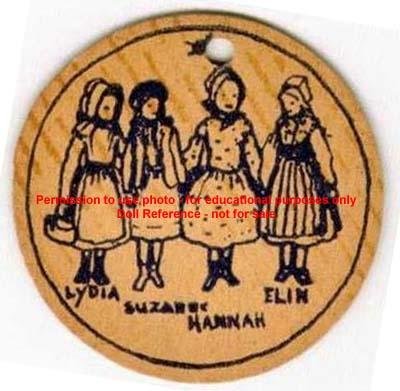
|

From the books of Marguerite de Angeli
- front of the Hedwig doll tag |

Lydia,
Suzanne, Hannah, Elin
- back of Hedwig doll tag |
Marguerite's friend Hedwig Ryglewicz, who was a
very accomplished seamstress, volunteered to costume the dolls in
outfits depicted in the books, so it was decided that the dolls would
be called "Hedwig Dolls." It
was also decided that each doll would carry a 2" round, black and
yellow cardboard tag tied to its wrist (shown above front and back).
The early composition dolls with the
Mary Hoyer face mold are the most difficult to find and also the most
expensive to buy. The Hedwig dolls were produced during
the 1940s and 1950s as exhibit supplements used by book salesmen and
they could be purchased only through Doubleday. After a trip to New
York's doll manufacturing district to find an appropriate doll, Hedwig
and de Angeli ordered the first 100 dolls from the Ideal Doll Company.
They were made of composition, had five-piece strung bodies, painted
or sleep eyes, mohair wigs, and were 14" tall. They
were the very same dolls used by both the Mary Hoyer
Doll Company
and the Arranbee Doll
Company. The Hedwig dolls carried no identifying head or body markings
at all, ever. This is one reason they are so hard to identify
today, particularly if their original ethnic clothing has been lost
and they are redressed.
When the doll project began, Hedwig
quit her job and devoted more than two years to costuming the first
100 dolls. Pouring over Marguerite's children's books, Hedwig
carefully chose which costumes to copy, and then she and de Angeli
made a whirlwind trip to New York's garment district to find exactly
the right fabrics and trims to use. The resulting costumes were little
works of art, meticulous in every tiny detail. Hedwig also
custom-designed the mohair wigs for the dolls she planned to dress
first, and she paid particular attention to making authentic
hairstyles. For example, Quaker Hannah's hair is brushed away from her
face and pinned at the back of her head, just as her faith dictated,
and Swedish Elin's hair is neatly braided. French-Canadian Suzanne's
blonde hair falls loose in a mohair bob, and Amish Lydia's auburn
braids are twisted into a bun at the nape of her neck.
Originally, Hedwig designed the four
girl characters, (shown at top) based on Marguerite de Angeli's books,
but more characters were added as books were published, including
three more girls and two boys. Both the dolls and their costumes
varied over the years, but the costumes were always meticulously sewn
by Hedwig, and they always depicted the exact costumes worn by
the characters in the books. The costuming was accurate right down to
the number of buttons and the size and type of trim decorating the
skirts.
Hedwig costumed and wigged the
de Angeli character dolls over a period of about 20 years and there are many
differences between the early dolls from the 1940s and those purchased
and costumed later. The
April doll (from the book; Bright April 1946), for example, was a cheap hard plastic doll produced in the
1950s, but she is still sought out and valued by collectors, because
she is a Hedwig doll.
|

Anelia
& Cecelia dolls, 14"
both blondes, both dressed in their Polish outfits |

Bright
April doll 14" - a black doll |
|

Elin
doll,
14",
Swedish, braided blonde hair |

Suzanne
doll,
14",
French Canadian, blonde |
|
|
In all, Hedwig created nine character
dolls based on Marguerite de Angeli's books - Anelia doll (Polish,
blonde hair), Cecelia
doll (Polish, blonde hair), April doll (African American, black doll),
Elin doll (Swedish, braided blond hair),
Hannah doll (Quaker, brunette
hair in a ponytail),
Lydia doll (Amish, auburn braided hair twisted into a
bun), Suzanne doll (French-Canadian,
long blonde curly mohair wig),
Tadd (boy doll) and Yonie Wondernose (blonde boy doll), all
dolls are 14" tall. It is not known exactly how many dolls were produced altogether, but
it is believed that fewer than 100 complete and original dolls
are still in existence. Most of the known dolls are currently held by
de Angeli's heirs and friends or by private collectors and they are seldom
if ever sold on the open market. When found, the Hedwig dolls are
highly prized by those collectors who are aware they exist and now you
know too.
|

Lydia
doll 14",
Amish, auburn hair (Andrea's Doll) |

Hannah
doll 14",
Quaker, brunette hair |
|

Yonie Wondernose doll 14", from the 1944
Yonie Wondernose book by De Angeli |

Tadd doll 14", from
the 1938
Copper-Toed Boots book by De Angeli |
Yonie Wondernose doll
a blonde haired boy from the book of the same name, wears denim bibbed farmer jeans with a red shirt, straw hat and bare feet and
the Tadd boy doll from the Copper-Toed Boots book wears a brown jacket
and pants, shirt, hat and brown boots, are the hardest of the Hedwig dolls to find.
Sincerely,
Andrea
Thanks to the
contributions from the following and permission granted for the use of
their photos by:
Lydia, is Andrea's own
personal doll and is the author of this doll article
Jane Curtis, children's
librarian at Lapeer District Library, Lapeer, Michigan
Jan Foulke, renown author
of "Blue Book of Doll Values" and many other doll books
Judith Hines, family
friend of the de Angeli family
Chadd's Ford Historical
Society, Chadds Ford, Pennsylvania
The Publishers of Doll
Reader Magazine article on de Angeli-Hedwig dolls can be found in
the May 1988 issue.
Arranbee R & B |
Ideal |
Mary Hoyer
Cookie
Policy |
Privacy Policy |
About Us
All trademarks are respective of their owners with no affiliation to this site
Doll Reference © Copyright 1999-2026 all rights reserved including photos & content
|